The $3 Trillion Stash
by Will Becker, AWMA/AIF
Happy Friday!
Investment Perspective
Today's update is focused on repatriation of offshore* corporate profits. Sounds exciting, right? Are you rolling your eyes already? It might be the single largest economic event of the year, so I need to address it... and I promise I tried my darndest to make it as unboring as I could! As a reward for wading through this topic, there is an animal video at the bottom. :)
Imagine for a moment that you run a company, and your company sells about 2/3 of its products abroad. It's a big company with a lot of sales, and you would like to bring that money back to the U.S. so you can use it here. But there is a 35% tax on bringing that money here, so you leave most of it abroad and just bring a small portion of it over each year. Then you wake up one morning and that tax I just mentioned is suddenly as low as 8%. Say what? Lookin' good! Remember all that debt you added to buy another company? Now you can pay it off much faster! Good times! Now imagine that your company makes jet engines and elevators, your name is Greg Hayes, and your company is United Technologies.
In a nutshell, that is what's playing out with the lower tax rates on "repatriating" overseas* profits. Until now, companies with overseas profits could find ways to not pay U.S. taxes on that money as long as the profitsstayed overseas. Since bringing the profits onshore resulted in a 35% tax rate, many companies kept stockpiling funds abroad... until they collectively amassed about a $3 Trillion stash. That stash was in bank accounts (which provides the bank with capital to lend) and U.S.Government & Corporate bonds, according to Michael Cahill from Goldman Sachs. Heestimates that Apple, Microsoft, and Google hold over $500 billion in U.S. government bonds and corporate debt in these offshore* accounts, for example. But notably, this stashed money is not building new buildings (See Apple below), paying off Debt (see United Technologies above), etc. In economic terms, it is not a particularly productive stash. Then the new Tax Bill comes along with a provision that allows companies to bring overseas profits back to the U.S. - for a limited time - at a reduced tax rate that is as low as 8%.
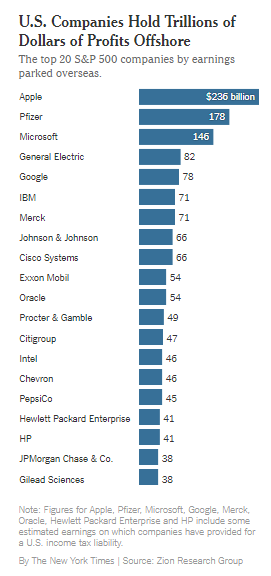
As taxes go, that's a big deal. As money goes, it's a LOT of money. Apple has around $236 billion abroad*, "Microsoft holds $146 billion in overseas earnings, Pfizer $178 billion, General Electric $82 billion, Alphabet $78 billion, and Cisco $71 billion, according to estimates from the Zion Research Group." Below is a chart showing Offshore profits. We know from Quarterly Financials calls that the money is already flowing onshore - resulting in over $70 billion in tax payments from Apple, Citigroup, Goldman Sachs, Bank of America, American Express, and JP Morgan Chase. To put this in perspective, Apple's foreign stash is the size of Finland's entire Gross Domestic Product. Let's play the hypothetical game for a moment. If just half of the overseas cash returns... that is equivalent to the entire Gross Domestic Product of Canada. Not bad, eh?
Is it economically a big deal?
Setting aside where the money is coming from (more on that below), the real question is what this repatriated money will fund. Notwithstanding the United Technologies example above, there is a cautionary tale from 2004, as reported by Business Insider:
There is a "corporate mystery that had long baffled economists. In 2004, after heavy lobbying by our Corporate Titans, Congress declared a “repatriation holiday” to encourage the “return” of $300 billion in overseas cash to be invested in the US. This would cause a burst of investment and hiring in the US, it was said. This was similar to what Moody’s is now clamoring for on behalf of its clients, except this time, they want permanent tax reform rather than a one-time “repatriation holiday.” In 2004 many companies repatriated these "profits that were then taxed at the special and minuscule rate of 5.25%. And then nothing happened. There were no investments and no hiring and no benefits for the economy because the money had already been deployed in the US, as we now know. In May 2013, as a result of the Senate hearings, the New York Times summarized the 2004 phenomenon this way:
"On the contrary, some of the companies that brought back the most money laid off thousands of workers, and a study by the National Bureau of Economic Research later concluded that 92 cents on every dollar was used for dividends, stock buybacks or executive bonuses."
Is this time different?
BlackRock's Larry Fink suspects that the onshored cash will not be very stimulative, but instead will be spent rewarding shareholders - not necessarily investing in the companies. On the other hand, Jamie Dimon from JP Morgan Chase, points out that "If all companies did [with repatriated funds] was pay dividends and buy back stock, think of that as QE4 ... and far cheaper, in my opinion," Dimon said, comparing the stimulative effect to that of the Federal Reserve's multiyear monetary easing. The 2018 version appears to be turning out different than 2004, at least thus far. Aside from the United Technologies example, Apple said it will "make $30 billion in capital expenditures in the U.S. over the next five years, in part from opening data centers to feed growing demand for services like iCloud. And it will create over 20,000 new jobs at existing Apple campuses and a new one, initially for technical support, at an unnamed location, likely setting off a scramble among states and cities vying for bragging rights." That is not at all what happened in 2004.
*So what is up with the Asterisks, and where is all this overseas cash?
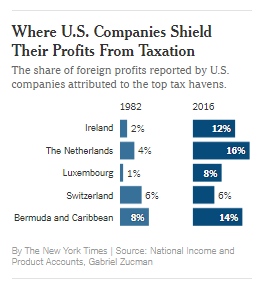
I want to say that all that overseas cash is... "Abroad, duh!", but it's not actually that simple. According to a recent article in the New York Times (chart below), The Netherlands, Bermuda/Caribbean, Ireland, and Luxembourg are the top locations, at least as reported by U.S. Companies. But it turns out that "abroad" can also mean, well, I'll let Business Insider explain:
"according to the Senate report, Apple doesn’t have to repatriate that moolah because it’s already in the US. The Irish mailbox subsidiaries, on whose books this money is for tax purposes, transferred it to Apple’s bank accounts in New York. The money is managed by an Apple subsidiary in Reno, Nevada, and is invested in all kinds of assets in the US. Apple’s accountants in Austin, Texas, keep the books."
That's not nearly as exciting as bags of money flying in from illicit locations. But I'll take it.
You made it! Here is your Animal video. :)
Disclosure: This commentary on this website reflects the personal opinions, viewpoints and analyses of the DeDora Capital, Inc. employees providing such comments, and should not be regarded as a description of advisory services provided by DeDora Capital, Inc. or performance returns of any DeDora Capital, Inc. Investments client. The views reflected in the commentary are subject to change at any time without notice. Nothing on this website constitutes investment advice, performance data or any recommendation that any particular security, portfolio of securities, transaction or investment strategy is suitable for any specific person. Any mention of a particular security and related performance data is not a recommendation to buy or sell that security. DeDora Capital, Inc. manages its clients’ accounts using a variety of investment techniques and strategies, which are not necessarily discussed in the commentary. Investments in securities involve the risk of loss. Past performance is no guarantee of future results.