Where Is The Wage Growth?
by Will Becker, AWMA/AIF
Happy Friday!
The Wage Growth Problem.
This week's update drills down on a topic that we have discussed a few times, but warrants a deeper perspective. In our conversations with clients and employers, an increasing topic is the tension between economic recovery and employment.
We hear two common refrains:
- employees saying "If unemployment is so low, why is it so hard to find a good paying job and a higher wage?" (while housing, education, and health care costs increase rapidly)
- employers saying "If there are so many job seekers, why can't I find qualified candidates for my jobs?"
These seem conflicting, but they are actually exactly what is happening in the job market.
Let's dig in, starting with Wage Growth.
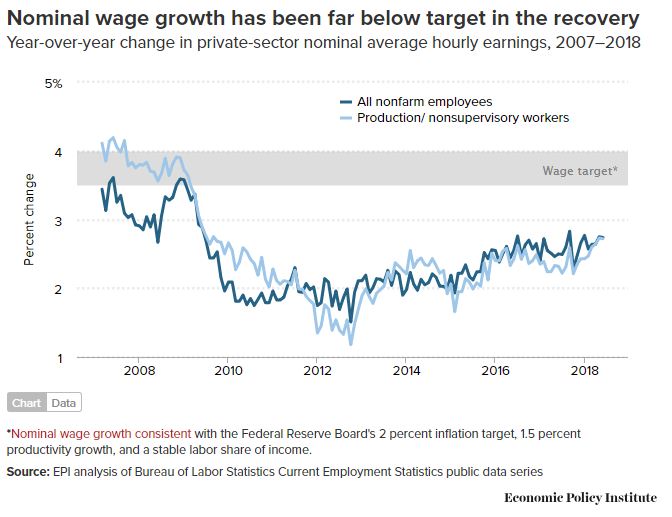
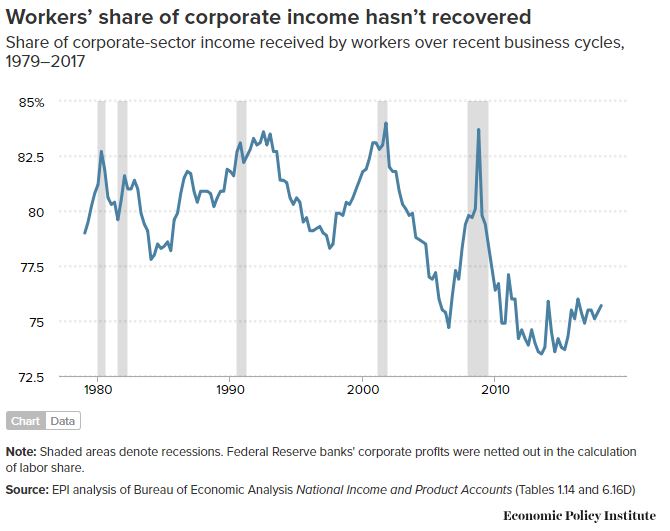
As CNBC recently said, "The June jobs report brought with it almost universally good news, unless you're a worker looking for a substantially fatter paycheck." Unemployment is historically low, and the "quit rate" that I wrote about last time is high. Bloomberg aptly summarized the issue in one sentence: "But wage growth is still noticeably slower than many economists and analysts expect (despite all the stories about employers desperate for workers)." The Economic Policy Institute reports that not only are wages still lagging, but workers' share of corporate income still has not recovered (see images below).
There could be some nuanced reasons for the slow wage growth. Bloomberg floated a few theories:
- "Employers’ reluctance to reduce the wages of existing workers during the Great Recession may have created a backlog of wage cuts [and debts to pay down] that must be worked through. They find that industries least able to cut their workers’ pay during the recession have also experienced slower wage growth during the recovery."
- "Companies are making it easier for applicants to get their foot in the door — they are less likely to demand background checks, for example, which in effect increases the number of workers they can choose from, relieving some pressure to increase wages."
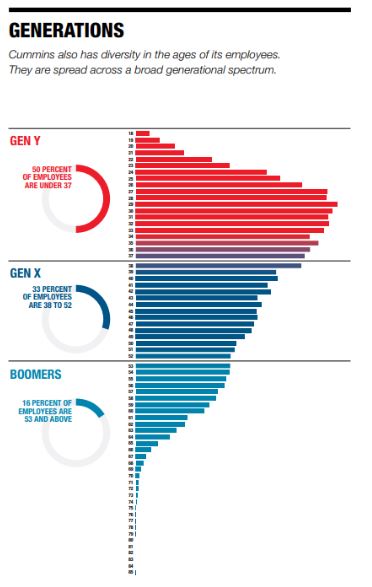
- "There is evidence that higher-wage older workers have been retiring, leaving the labor market, while lower-wage younger workers have been entering. This would slow overall wage growth." To illustrate this last point, check out youthfulness of the Cummins workforce in the image below.
If you are an employer reading this, the experience may be very different. There are jobs with increasing wages. Lots of them. Many of our Clients that are employers are dealing with hiring and retention issues in highly industry-specific occupations where there is a glut of new business, but a dearth of qualified staff. There are some examples of these jobs and industries below when I get into regional variation.
Now to the mismatch between Jobs and Qualifications
There are now more job openings than there are eligible workers to fill them. However, and this is the crux of the issue, there is a mismatch between what employers are looking for and the qualifications of the candidates. This is partly regional, partly industry-specific, and partly based on where we are in the business cycle.
CareerCast.com reviewed Bureau of Labor Statistics forecasts, trade and professional association data, graduation rates, and their own site's database of job listings to compile an aptly named report of the "Toughest Jobs to Fill in 2018."
Below are the top 10 jobs from the study, along with their Median Salary. To illustrate the wage difference, I sorted them from highest wage to lowest wage. What do these in-demand jobs have in common? They tilt heavily towards Health Care & Technology, are difficult to automate, and tend to have specific skillsets or licenses.
Toughest Jobs to Fill in 2018:
- Nurse Practitioner $110k
- Application software developer $101k
- Medical Services Manager $96k
- Information Security Analyst $92k
- Financial Analyst $84k
- Physical Therapist $84k
- Truck Driver $42k
- Construction Laborer $33k
- Home Health Aide $23k
- Personal Care Aide $23k
How is this playing out regionally?
In the North Bay, there is a dearth of Framers. This is what DeNova Homes, a large home builder in the region, cited for canceling their plan to rebuild homes burned in the Santa Rosa fires. They went so far as to say “The framers are always a key player in any project. As of right now, it is constantly a struggle to have enough of them to support the day-to-day construction industry, aside from the rebuild efforts.”
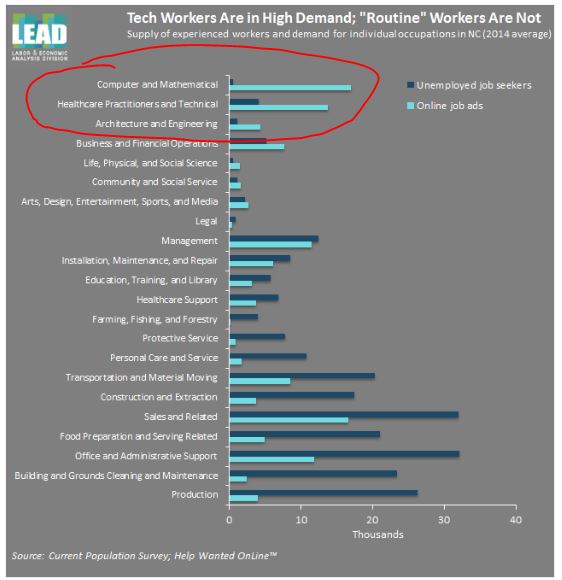
North Carolina, on the other hand, is short on Computer/Mathematical/Health Care/Architecture & Engineering (image below). North Dakota and Alaska are notoriously short on welders and service technicians in the pipeline industry, while regions with large wind and solar energy installations are facing long-term shortage of qualified technicians to install and service the equipment.
Similar to DeNova Homes citing the lack of Framers as their reason for passing up work, Tim Olson from the Solar Foundation reported that solar employers are “turning down jobs because they just can’t find qualified workers." Earlier this year we spoke with a Solar company that invested heavily in their technology to remotely monitor solar arrays in order to reduce their reliance on field technicians (expensive & hard to hire). Outcome: more software engineering work, less field technician work.
How does this play out going forward?
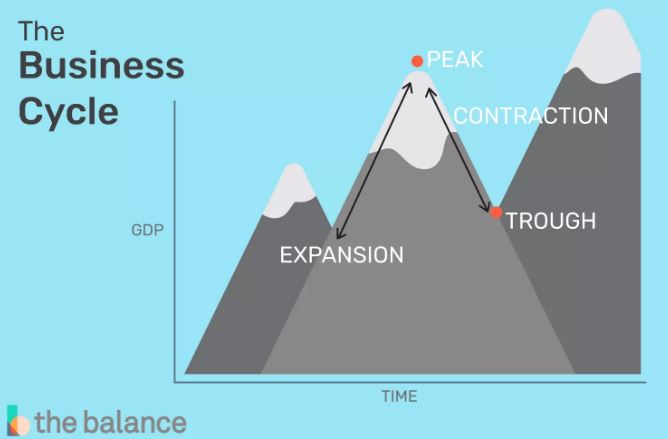
Labor, inflation, corporate profits, and the business cycle go through a long term cycle. What we are seeing now is consistent with the latter stages of Business Cycle expansion. The direction is towards increased GDP, increased Inflation, interest rates continuing to rise, and the labor market continuing to tighten.
But this update is focused more specifically on the labor market, so here is the basic outline of how the labor market interacts with Inflation and Profits:
- Wages stagnate and there are lots of jobs, so employees are more likely to job-hop (i.e. Quit Rate increases)
- Employers raise wages to attract and retain employees (i.e. Wage Growth)
- Rising wages increase inflation and reduce profits (i.e. Inflation up, Corporate profits down)
- Increased inflation pushes the Federal Reserve to raise interest rates (i.e. interest rates up, corporate debt service up, profits down)
- Reduced profits cut into corporate earnings projections (i.e. future earnings estimates down)
- Stock prices fall as the lower earnings are priced in (i.e. "pullback")
- Companies cut jobs to maintain profit levels (i.e. layoffs, unemployment increases)
- ... and the cycle continues
Disclosure: This commentary on this website reflects the personal opinions, viewpoints and analyses of the DeDora Capital, Inc. employees providing such comments, and should not be regarded as a description of advisory services provided by DeDora Capital, Inc. or performance returns of any DeDora Capital, Inc. Investments client. The views reflected in the commentary are subject to change at any time without notice. Nothing on this website constitutes investment advice, performance data or any recommendation that any particular security, portfolio of securities, transaction or investment strategy is suitable for any specific person. Any mention of a particular security and related performance data is not a recommendation to buy or sell that security. DeDora Capital, Inc. manages its clients’ accounts using a variety of investment techniques and strategies, which are not necessarily discussed in the commentary. Investments in securities involve the risk of loss. Past performance is no guarantee of future results.